INWOMEN’S

   HEALTH

Issue #167  ·  October 20, 2026

What the New Women’s Health Executive Order Actually Does

A new division, a new task force, and what still needs Congress.

This week’s job listings

94 open roles  ·  24 companies

Handpicked from across the women’s health ecosystem this week

Browse all roles →

All your IWH Pro benefits, tools, events, and job matches in one place. Join IWH Pro →

From Jodi  ·  Policy

What the New Women’s Health Executive Order Actually Does

I was in the Rose Garden on Monday. Here’s what the order does, what it doesn’t, and what to watch.

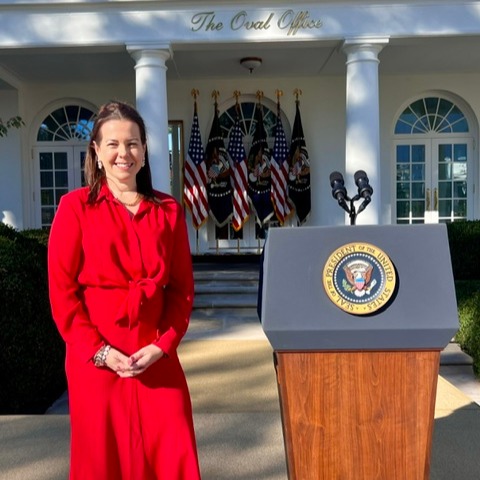
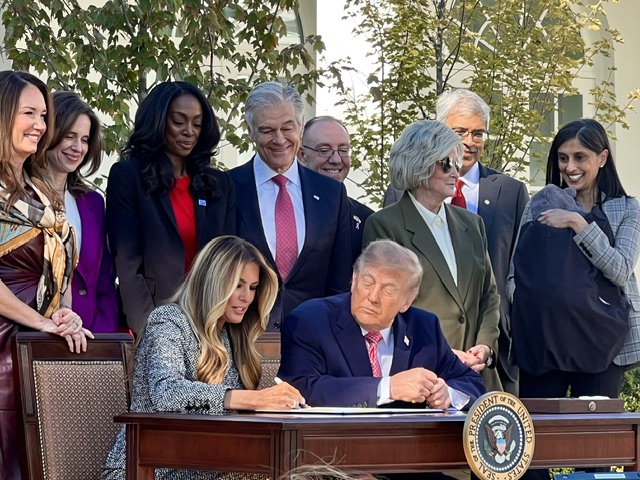
On Monday, I was in the Rose Garden when the President signed the Executive Order on Advancing Women’s Health to Improve Outcomes in All Phases of Life. By Monday night, my phone was full of the same question asked a dozen different ways: so what does this actually do?

Executive order signing in the Rose Garden
Jodi Neuhauser at the White House

In the Rose Garden on Monday.

The headlines were short, the order is vague, and the structure underneath it is confusing, so let’s start with what existed before.

Two offices: HHS + NIH

Before Monday, there were two offices of women’s health within HHS:

  • Office of Research on Women’s Health (ORWH). It sits in the NIH Director’s office, was established in 1990, and was written into law in 1993 (42 U.S.C. §287d). Its job is to coordinate women’s health research across all of NIH’s institutes, but with a budget of roughly $100 million it funds very little research directly.
  • Office on Women’s Health (OWH). It sits in the Office of the Secretary at HHS and advises the Secretary on women’s health policy across all HHS agencies. It was established in 1991 and written into law by the Affordable Care Act in 2010 (42 U.S.C. §237a).

Now, Monday’s EO

The heart of the order is a new Women’s Health Division and a Women’s Health Task Force. The division will sit inside the National Institute of Child Health and Human Development (NICHD), part of the National Institutes of Health (NIH), and work alongside ORWH.

Because NICHD has a budget of approximately $1.7B, the new division can draw on existing funding right away. In FY25, NICHD spent approximately 30% of its budget on women’s health research (about $510 million). The next lift is securing additional FY27 funding for the division, and people I’ve talked to on the Hill and within HHS feel confident.

So how does this all fit together?

I drew this on a napkin for a reporter on Monday:
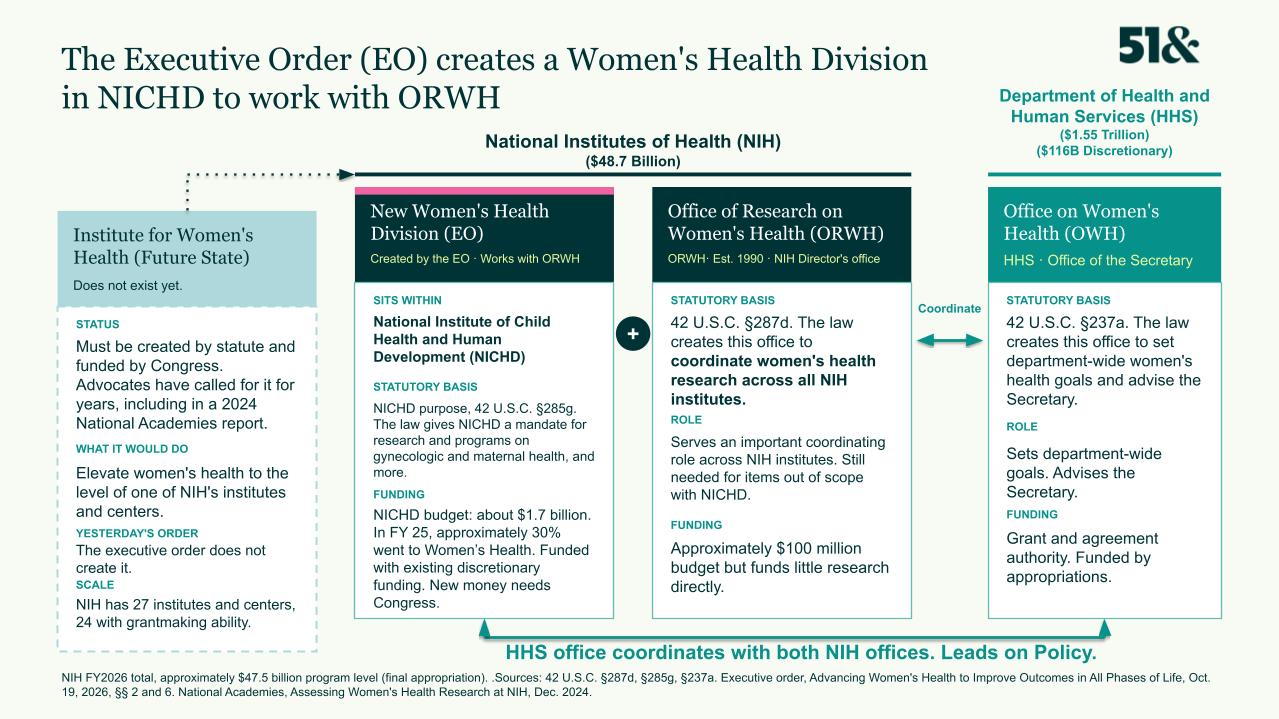
The executive order creates a Women’s Health Division in NICHD to work with ORWH. Four structures: the proposed Institute for Women’s Health (future state), the new Women’s Health Division inside NICHD, the NIH Office of Research on Women’s Health, and the HHS Office on Women’s Health.
  • Institute for Women’s Health (future state). Does not exist yet. Congress has to create and fund it, and advocates have asked for one for years, including in a National Academies report. The order does not create it.
  • New Women’s Health Division. What the order creates. NICHD’s purpose in law already covers gynecologic and maternal health, so the division can start now.
  • ORWH and OWH. ORWH keeps coordinating across all 27 NIH institutes, and OWH stays the policy arm at HHS.

What about the task force? Why is it run by a man?

It is technically run by both Robert F. Kennedy Jr. and Susie Wiles, President Trump’s Chief of Staff. The order names the roles, not the people, and eleven other officials sit on it by title. Its job is a comprehensive approach to women’s health across every stage of life, and the co-chairs can hold public hearings, meetings, roundtables, and similar events, as appropriate. The first meeting happened on Monday after the announcement.

Here is what I think is missing. The order sets no deadline and does not require a report, so what the task force produces and when is up to the co-chairs. I’ll follow up to see if they will do a public RFI, how our industry can get involved, and how they will measure success.

Does it have any money?

Some, but not new money. An executive order can’t appropriate funds, only Congress can, so it’s not accurate or fair to say “this doesn’t have any money.”

Because the new division will be housed within NICHD, it will be able to leverage the institute’s existing discretionary funding immediately. Given the bipartisan support for women’s health, both people on the Hill and at HHS are optimistic that Congress will appropriate additional funding in the next fiscal year.

For scale, the National Academies recommended about $15.7 billion in new funding over five years for women’s health research, and the coalition behind the Society for Women’s Health Research’s national strategy is asking Congress for $20 billion over ten years.

“So far, Congress has been the backstop.”

Didn’t they cut women’s health funding?

Parts of it, yes. The Washington Post reported that NIH-funded projects including the word “women” fell 31% in 2025. Senate Appropriations Chair Susan Collins, a Republican, raised that with Secretary Kennedy in April and called it a problem if grants are screened for the word and then cut. NIH says its reviews are based on scientific merit. HHS also cut funding for the Women’s Health Initiative in April 2025, then restored it quickly after public backlash, according to The New York Times. And the FY26 budget request proposed cutting NIH by about 40%, which Congress rejected. So far, Congress has been the backstop.

What about the earlier orders it revoked? And abortion?

The order rescinded the earlier Biden executive order, but this is common as administrations change, and I wouldn’t read too much into it. This happens on both sides of the political spectrum. The work from that EO is already complete, the funding allocated, and the work continues. So nothing has been erased. The EO also stays away from abortion, which I would expect and is the political reality right now, but it does cover maternal health, infertility, and endometriosis.

What happens next

What I would watch:

  1. How the division is set up inside NICHD and works with ORWH.
  2. Whether the next appropriations cycle includes new money for the division. That is the real decision point, and where we can play the biggest role.
  3. What we start to hear from the task force about reports, RFIs, industry involvement, and more.

Final thought

Is the EO perfect? No. Do we want more for women’s health? Yes. But I’m a pragmatist, and our job is to work with whoever is in office and has the ability to change things, whichever party that is. Knowing which office does what, and what needs Congress, is the difference between reading the news and being able to act on it.

I’m doing a Q&A on all of the above on Friday, October 23 at 3pm ET. Bring your questions.
RSVP for Friday’s Q&A →
Jodi

Jodi Neuhauser, Founder & CEO, In Women’s Health

🔑 New Summit dates drop soon. Seats are limited.

Reimbursement came up on almost every panel at WHIS. Our next Summit gets you ready before the rules change in January.

Three days, built on two years of summit work. Day 1 is a working session on the core problems in women’s health reimbursement and the solutions we’ve mapped, with room for your comments and needs. Day 2 covers the Physician Fee Schedule and quality as a reimbursement lever, from the final rule to 2027 rulemaking plans. Day 3 makes it real with maternity unbundling: what the final rule says, what it means with Manatt and Tribunus, and how to think about your payer contracts.

Dates are coming out soon and seats are limited, so the waitlist hears first. Payment plans will be available when registration opens.

3

days


🎤

guest speakers


💳

payment plans

Presented by In Women’s Health with Tribunus Health · New dates and speakers coming soon

💳 Group, employer and community rates

Group and employer rates are available. Last time around, plenty of attendees had their employer cover the cost, and teams that came together got a group rate. IWH community members get a community discount as well. Reach out to Genny-Marie Spencer for group, employer, and community pricing. [email protected]

Join the waitlist →

Early bird pricing to be announced · Seats are limited · Payment plans available once registration opens · Group, employer, and IWH community rates available. Join the waitlist to be the first to know when dates and pricing are announced.

⭐ Featured roles

Three we’d apply to this week

Head of Community and Business Development

Flourish CareRhode Island / Massachusetts

$  $120K-$150K

Flourish Care runs one of the country’s largest insurance-covered doula networks, available to more than 20 million covered lives through commercial plans and Medicaid.

Why we flagged it: Maternity unbundling starts January 1, and care between visits is about to get much easier to see and bill. This role builds the partnerships that turn that shift into covered care.

Apply now ›

Chief of Staff

Clair HealthMenlo Park, CA

$  $120K-$150K

Clair Health is building a noninvasive wearable that continuously tracks women’s hormones, backed by an $11.6M seed round led by Khosla Ventures ahead of its November launch.

Why we flagged it: A chief of staff seat right before launch is a front-row view of everything. It’s also a bet on biometric data that backs up what women are already telling their doctors.

Apply now ›

Independent Board Director (2 seats)

51& FoundationVolunteer board role

★  Volunteer · 4 meetings a year

51& Foundation is the new nonprofit arm of 51&, making grants in women’s health research, policy, reimbursement reform, narrative change, and infrastructure. It’s filling two independent seats: a legal, philanthropy and grant-making leader, and a physician with deep roots in women’s health.

Why we flagged it: Reimbursement reform is one of the five grant areas, and this seat helps decide where the money goes. Four 90-minute meetings a year on a two-year term makes it a real way to build board experience alongside your day job. To apply, email your resume to [email protected].

Email your resume ›

Quick take

⚖️ This vs. That  ·  Payment reform vs. delivery reform

Payment first vs. delivery first

This: Payment first

•  Changes the codes first and hopes better care follows

•  Opens the door to upcoding and more claim denials

•  Adds documentation and paperwork for practices


That: Delivery first

•  Starts with the care model that improves outcomes

•  Prices the result, not just the visit

•  Pays for what clinicians actually do, fourth trimester included

Why it matters: Maternity unbundling is payment reform arriving first. Neel Shah’s point at WHIS was simple: show the delivery model, then pay for it. The companies that win in 2027 will be the ones that can show the care behind the codes.

🔍 Try it this week

In your next interview or partner call, ask two questions: what care model is this company getting paid for, and who pays for it today? The answers tell you more about where it’s headed than the pitch deck does.

$1Ta year in global GDP by 2040 if we close the women’s health gap. Reimbursement is how that number turns into paid care.
McKinsey Health Institute & World Economic Forum, 2024
 

In the community

Thank you, Boston. See you in Las Vegas.

Last week during WHIS 2026, 25 to 30 of you joined us for an in-person IWH happy hour. Some familiar faces, plenty of new ones, and more than a few intros we expect to turn into something. Thank you to everyone who came out.

IWH community happy hour at WHIS 2026 in Boston

Next stop: HLTH USA, November 15-18

IWH is headed to HLTH USA at the Venetian Expo in Las Vegas. Jodi’s mainstage panel will be announced soon, and we’re planning another in-person IWH happy hour while we’re there. More details to come.

IWH community discount

26HLTH_InWomensHealth

Use this code for $250 off your HLTH USA pass.

Get your HLTH pass →
Stay in the know on upcoming events by following our Luma calendar →

📅 Upcoming events

Get in the room

⭐ IWH Members Only

IWH November Office Hours

Friday, November 13, 2026 · 3:00pm ET · Virtual

Confidential, members-only office hours with founder Jodi. Bring interview debriefs, resume questions, or career-progression questions to a small peer group.

RSVP ›

IWH · Free · Virtual

October Monthly Women’s Health Career Networking

Friday, October 23, 2026 · 2:00-3:00pm ET · Virtual

Spend time getting to know others in our industry, hear the latest industry insights, and leave with new intros you can act on this week. Bring your asks.

RSVP ›

IWH · Open to all

Inside the White House Executive Order on Women’s Health

Friday, October 23, 2026 · 3:00pm ET

A live Q&A on Monday’s executive order: what the new division and task force actually do, what still needs Congress, and how our industry can get involved. Bring your questions.

RSVP ›

See the full IWH events calendar →


This week’s job listings

94 open roles

across 24 companies hiring in women’s health this week

Browse the full job listings →

58

Clinical & In-Clinic

23

Business, Ops & Legal

4

Product, Eng & Data

4

International

3

Other

2

Freelance & Contract

P.S.

Maternity unbundling starts in about ten weeks, which is also roughly how long it takes me to unpack after a conference. Hit reply with the one reimbursement question you want answered at the Summit, and I’ll do my best to get it on the agenda.